

Textured Backdrops vs. Solid Color Backdrops: A Photographer’s Guide
May 4, 2026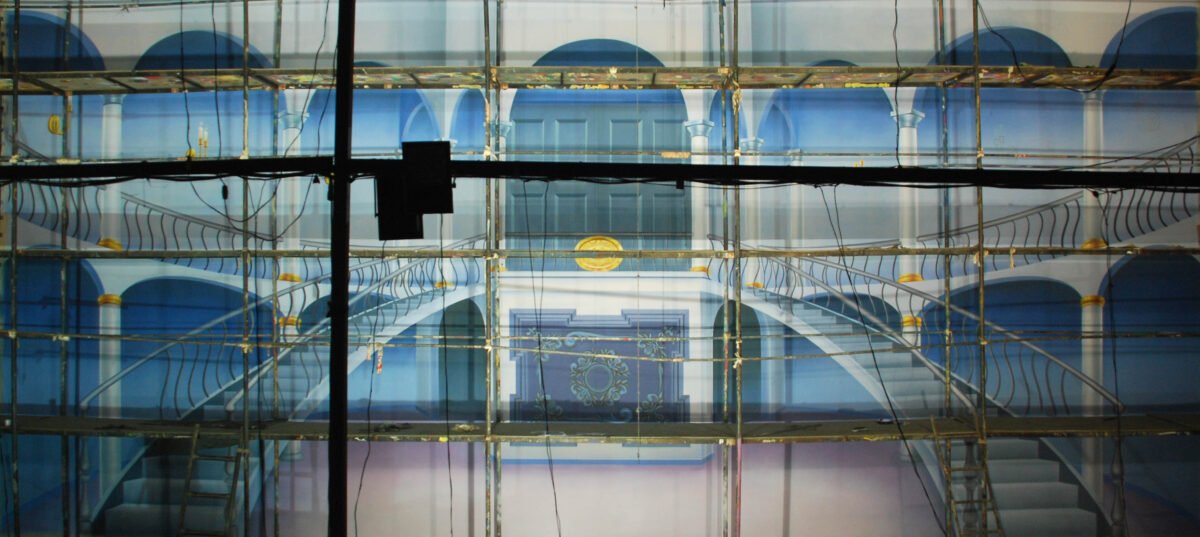
When theatre directors, production designers, and choreographers imagine a perfect stage, they often picture a sweeping backdrop that transports the audience to another world entirely. That seamless illusion — a sun-drenched Tuscan landscape, the gaslit streets of Victorian London, or an otherworldly ballet dreamscape — does not happen by accident. It is the result of weeks of skilled, painstaking work carried out in Agraffitti’s painting workshops by a team of dedicated artists.
This is the story of how a large-scale handpainted theatre backdrop comes to life — from the first conversation with a client to the moment it is rolled out onto the stage floor.
Step 1 — The Brief: Where Every Backdrop Begins
Every handpainted theatre backdrop starts with a conversation. A director shares a vision. A choreographer describes an emotional landscape. A production designer hands us a mood board or a pencil sketch on a notepad. Our job, at this earliest stage, is to listen.
The information we gather at this point drives every decision that follows: scale, color palette, fabric type, the level of detail required, and the atmospheric quality the backdrop must achieve under stage lighting. Theatre backdrops are not simply painted pictures — they are environmental storytelling tools, and they must work in harmony with lighting rigs, performer movements, and the sightlines of an audience seated at varying distances from the stage.
Key questions we explore during the briefing phase include:
- What is the production — a musical, a drama, a ballet, a children’s show?
- What are the stage dimensions? What is the fly height? How much of the backdrop will be visible at any given time?
- Will the backdrop be lit from above, from the wings, or with specialized effects such as gobos or color washes?
- Does the backdrop need to be reversible, or will it be used exclusively for a single scene?
- What is the timeline from commission to delivery?
Step 2 — Design Development and Approval
Once we have a clear brief, our design team begins translating the concept into a visual reference. For most large-scale theatre backdrop commissions, this involves producing a scaled color sketch or a digital visualization — sometimes both. This document serves as the creative contract between Agraffitti and the production team.
Every detail is reviewed at this stage: the horizon line, the depth of perspective, the ratio of sky to ground, architectural elements, foliage, atmospheric effects, and the color relationships between the foreground, mid-ground, and background. Lighting conditions on stage can dramatically shift how colors read, which is why our team draws on years of experience working with theatrical lighting designers to anticipate how the finished piece will appear under performance conditions.
Revisions are welcomed and expected at this phase. It is far more efficient to adjust a sketch than to repaint a 40-foot canvas.
“The design approval is the most critical moment in the entire process. Once the brush touches the fabric, we are committed. Getting the brief right saves everyone time, money, and disappointment.”
Step 3 — Fabric Selection and Preparation
Agraffitti’s theatre backdrops are predominantly painted on high-quality muslin — the same fabric that has been the industry standard for theatrical backdrops for over a century. Muslin offers an ideal combination of weight, texture, and flexibility. It absorbs paint beautifully, resists wrinkling after being folded for storage and transport, and maintains its structural integrity after repeated uses and washings.
For special productions, we may also use tightly woven canvas or synthetic theatrical fabrics, depending on the visual requirements of the design and the preferred handling method on-site.
Fabric preparation is a critical step that is often overlooked in discussions of the painting process. Before a single brushstroke is applied, the fabric must be:
- Washed and treated to remove any sizing or surface treatment that might resist paint adhesion.
- Stretched and secured to our workshop floor using a grid of anchor points to prevent distortion during painting.
- Primed with a base coat appropriate to the color palette — typically a toned neutral that allows subsequent layers to build depth and luminosity.
Step 4 — Scaling the Design Onto the Fabric
With the fabric prepared and lying flat on the workshop floor, our artists scale the approved design up to its full dimensions. For a typical large theatrical backdrop, this can mean working on a surface anywhere from 20 feet wide to 60 feet wide, and up to 30 feet in height.
The scaling process uses a grid method — the approved design is divided into a precise grid, and each square of the design is proportionally reproduced on the full-scale fabric. This technique, which has been used by artists for centuries, ensures that perspective, proportions, and compositional relationships are faithfully maintained regardless of the final size.
Our artists walk the length of the backdrop throughout this process, constantly stepping back to assess the composition from a distance — mirroring the experience of an audience viewing the finished piece from across a theatre.
Step 5 — The Painting Process Itself
This is the stage that defines Agraffitti’s reputation. The actual painting of a large-scale theatre backdrop is a physically demanding, highly skilled process that combines classical painting techniques with the pragmatic realities of working at scale on a horizontal surface.
LAYING IN THE BACKGROUND
Painting begins with the large background areas — skies, water, fields, architectural masses. These are applied with broad brushes, rollers, and in some cases, sponges or rags to create the foundational tonal atmosphere of the scene. This stage establishes the light source and the overall mood.
BUILDING MID-GROUND DEPTH
Once the background is dry, the mid-ground elements are painted in. Trees, distant hills, buildings, pathways, and other environmental features are rendered with increasing detail as they move forward in the composition. Perspective and atmospheric softening are applied carefully at this stage to create a convincing sense of depth.
FOREGROUND DETAIL AND FINISHING
The foreground receives the highest level of detail — the areas most likely to be viewed at close range by performers and audience members in the front rows. Texture, shadow, highlight, and fine detail are layered in here, often using smaller brushes and careful dry-brushing techniques to suggest surface texture without adding physical thickness to the fabric.
THEATRICAL EFFECTS AND ENHANCEMENTS
For productions requiring special visual effects, our team applies UV-reactive paints, metallic highlights, or iridescent finishes that interact with specialized theatrical lighting. These elements are invisible under standard white light but come alive under UV, colored gels, or directional spots — adding a layer of magic to the finished piece.
Step 6 — Quality Review and Finishing
When the painting is complete, the backdrop undergoes a comprehensive quality review before it is released for delivery. Our team reviews the finished piece both flat on the workshop floor and suspended vertically — as it will be seen on stage — to identify any areas requiring adjustment.
We assess for color accuracy against the approved design reference, tonal balance, the coherence of the perspective, the quality of fine detail, and the overall visual impact. Any areas of concern are addressed and repainted before the backdrop is signed off.
Finally, the backdrop is treated with a protective coat that guards against moisture, scuffing, and UV degradation. It is then carefully folded or rolled — depending on the production’s preference — and packed for delivery.
Why It Still Matters — The Value of Handpainted Theatre Backdrops
In an era where digital projection and LED walls are increasingly common on theatrical stages, the handpainted theatre backdrop endures — and for good reason. No digital display can replicate the organic warmth, the subtle texture, and the physical presence of a large-scale painting on fabric.
Handpainted backdrops interact with stage lighting in ways that digital surfaces simply cannot. The texture of the fabric catches and diffuses light. Painted highlights glow with a warmth that pixels cannot simulate. The depth of layered paint creates micro-shadows that shift as the lighting rig changes — giving the scene a living, breathing quality that is uniquely theatrical.
They are also durable, reusable across multiple productions, and entirely customizable without the ongoing technical infrastructure of digital display systems.
“A handpainted backdrop does not just decorate a stage. It builds a world that an audience can believe in.”
At Agraffitti Backdrops, this has been our craft since 2000 — and we remain as committed to it today as we were at the very beginning.
Whether you are planning a full-scale musical, an intimate ballet, or a dramatic stage production, our team is ready to bring your vision to life. Contact us to begin the conversation.